Showing posts with label Sewing Machines. Show all posts

Thursday, January 24, 2013

Juki TL2010Q v. French Double Weave

I suppose it wasn't the smartest thing in the world to do, but I decided to use my new Juki 2010Q straight stitcher to make a shirt of the double weave fabric I'd bought from Berman Textiles.  New machine + New fabric = Challenge^2.

After I washed the fabric, I was immediately struck by how light and fluffy it had become.  The slightest touch would send the weave in wild directions.  I use a rotary cutter, so I was also surprised when the ends of freshly cut fabric exploded into frays.  Of course, the cut crossed the weave and the injured warp threads danced around like live electric lines.

I felt like I was trying to sew airy cotton balls together, but I suspect there is a nylon fiber in the fabric.  It simply won't hold a crease and found it wandering away like spandex.  The Juki performed well.  The feed dog and presser foot seemed to have a firm stable command of the fabric.  It is a wonderful basting machine.  The 6mm stitch is very much like my 1970s Singer touchmatic.  I don't think I would have been able to sew this fabric as well with my Pfaff zig-zag stitcher.  I'm positive the larger hole in the feed dog plate would have created evil things to happen with this fabric.


Last night I added the cuff plackets.  No matter how much ironing I did, the fabric would unfurl itself as I stitched.  I thought I'd caught all the edges, but this morning I see I didn't. During the night the fabric spread itself out flat.  Hand stitching will fix this. [sigh]

Off to work!

Friday, March 23, 2012

My Singer 20U33 is calling me..

At this time last week, I had bought a Bernina 850 from a lovely lady in Bayonne. Lou Bratkowski, sewing machine craftsman, was pulling together a table, engine, knee lift, lamp for a final fitting over the weekend. As I've already told the story, I ended up with a Singer 20U.


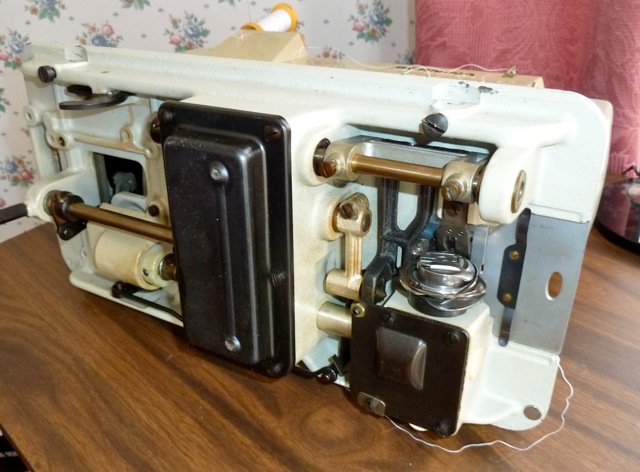
The machine came off a factory floor and into Lou's inventory of old soldiers. This one still has the pin wrap on the arm; pins still resting tightly in its grip. My first thought was to take the wrap off to make a better picture. I had a second thought about that wrap. Someone, however long ago, worked at this machine every day. It was their friend and their demon. That wrap is the only connection I have to that someone. It stays.

Monday, March 19, 2012

Making God Laugh

Thank you all for your kind words. There's a saying "If you want to make God laugh, tell Him your plans." Well, he had a good laugh on my account. When I showed up to the table shop with my Bernina for a final fitting and adjustment, to everyone's surprise the machine didn't fit the table cut out at all. The technician took my measurements in metric, converted them to American, determined that this was exactly the same as a Singer 20U, and cut the hole. Just as I started to say "how could you do that!!" .. the very upset technician blurted out that the Bernina 850 wasn't a true "commercial machine", but a home machine that was tricked out with a few commercial features. Look here, it doesn't even fit a standard commercial hole. My head was reeling.. a standard commercial hole?

The real business end of any machine is the needle, and the 850's needle size range is limited to light threads normally used in home sewing. If someday I wanted to make purses, the 850 might or might not be up to the task. Lo and behold, the shop did have a Singer 20U33 in good shape. So I negotiated a trade up on the spot.

The Singer 20U is a commercial artisan machine. It does only straight stitch and zig-zag in a most straight forward manner. None of the fancy cams internal to the Bernina. No large collection of presser feet. Equipped with a 3/4hp servo motor, The Singer 20U can pound through many layers of shoe leather. It can take industrial needles from size 10 (closest to home needles) to size 19 (I can make my own footballs size with V92 thread, oh joy). I haven't figure out the max stitch length or width yet, but I can do 2,500 stitches per minute. 2500SPM scared the crap out of me when I tried it! One extremely interesting aspect of this machine.. it does free form embroidery stitches.

The machine has two knee lifts. One lift is for the presser foot. I'm told that once you start sewing with a presser foot knee lift, you're finished for life with the lift bar. The second knee lift controls the zig-zag width and is normally used with a lever that controls the length. The technician told me that skilled operators can stitch flowers, symbols, lettering, and layers of stitches to form almost 3D sculpture on the fabric. If you've ever played an organ after a lifetime of piano lessons, you know it is a completely different skill set because you play keys with your feet. This might have possibilities!

I left home with a Bernina, and came home with a Singer. At least I am still true to my blog name. I might not be able to work on the robe for a few days. I have to move all my stuff out of a self-storage unit back into my house by Saturday. When I put my house up for sale, the broker told me I lived in too much clutter. So I moved my clutter to a storage unit. In six months, only 3 people looked at the house for 10 minutes and never called back. The house is off the market and my clutter is coming home.

One last surprise. The only part of the Cabaret Robe I sewed was the belt. I emailed pictures to the costume designer. About 2 weeks later she called me in a panic. The belt wasn't a belt. It was supposed to be a hem on the front edge of the robe. I think I have about 6 feet of seam ripping to do, very patiently too.

G'night.

Friday, March 16, 2012

The Curse of Craigslist Strikes Again

As I've mentioned in earlier posts I've been giving a lot of thought to trying to make a living by sewing. I'm convinced it's in my blood. All my ancestors, who were tailors, whisper to me in the rustle of fabric. But from decades of corporate marketing I know there are only two ways for a business to establish a sustainable competitive advantage (read Michael Porter's book on the subject) : either be the lowest cost producer or find a niche market than one can dominate. I cannot be the lowest cost producer, at least not without a lot of capital and luck. I have hints of what niche I might find. There are certain aspects of sewing I am attracted to: apparel, costumes, and practical applications. My sense is that by combining all three, I'll find my niche.

I have great admiration for Peter Lappin's MPB. He has indefatigable curiosity of vintage sewing. He is fearless in buying vintage sewing machines, making vintage clothes, organizing sew-along events, and commenting on media personages. I do find some cautionary tales he veils in humor. I have two Singers,two Pfaffs, and an Elna that are consumer home machines. Of these, I use my Pfaff 2046 the most. These machine can grow like mushrooms in the dark recesses of one's home. Peter knows.

For me these machines have been great tools to explore the possibilities. As my focus on my niche has sharpened, I see clearly I have no interest in quilting. I would go mad stitching those little squares into the beautiful works I see so many women create. I see their passion and if I might say, their addiction to it too. I have no interest in embroidery. There's a lovely and brilliant lady, named Bee, at the Pocono Sew'n'Vac who with every breath exhales a million embroidery projects. And she has TENS OF THOUSANDS of data files.

Are we sewists a bunch of pack rats? We have our collections of patterns, our stash of fabrics, and an endless array of things we want to make. I fear falling into that black hole myself, so I'm trying to limit myself to what I can keep in a small highly organized room. Small is good, he tells himself.

I've come to realize that my Pfaffs and Singers won't take me further in the direction I want to go. For that I need true commercial machines. Last November I acquired the Sailrite LSZ-1 because I see people are making a living doing boat covers, cushions, canvas sails .. practical things. I've watched the wonderful videos on their website and have just received their DVD on upholstering. When my wife started attending a draping class at Centenary College, she found herself struggling with her curve stick, corner square, drawing pads. I used my LSZ-1 to make a vinyl bag for here that could strap to the side of her portable sewing kit.


Sewing that bag for her gave me one of the hints I was looking for in making practical accessories. Some friends have asked me to make boat covers. I will in time.

When I made the seven elf jackets, I realized my Pfaff 2046 didn't have the horsepower I needed to sew the tough welt weave polyester quickly. Sewing the last couple of shirts and working on the robe for Cabaret convinced me that I needed a true commercial machine. My wife has a Juki DDL-555, which is one serious machine for straight stitching. It first came with an enormous clutch motor. When she turned it on, you could hear the roar of the engine from the street. I feared it would blow every circuit in the house. She did a lot of research an discovered a new motor technology called DC Servo and bought a Reliable SewQuiet 5000. It's a tiny extremely quiet box with enormous sewing power.


Recently I learned from one of the professors at Centenary's Fashion School that her students were not strong in construction because they were afraid to sew on the clutch motored commercial machines. She was extremely impressed when my wife showed her the SewQuiet motor. The college is now buying new commercial machines, possibly equipped with DC servo motors. Will this lead to a new generation of designers who are proficient in construction? Who knows. Technology has changed art many times in the history of man.

It's been on my mind that I should get a commercial machine, heavier than the Pfaff 2046 and lighter than the Sailrite LSZ-1. I wanted something that could straight stitch and zig-zag stitch. In the world of commercial machines, this is not cheap. I happened to be surfing Craig's List looking at the commercial machines when I stumbled on a Bernina 850 for $300. It seems to be the exact mix I wanted. It also didn't have a motor or a table; just the head and some feet. My research on this vintage machine described it as an artisan's machine, or as a semi-industrial machine. I decided to take a chance and buy it.


The lady who sold me the machine gave me a bolt of heavy canvas with a nautical print done specially for the Mystic Seaport Museum. Though I made the Cabaret Robe in a doll size, I decided I want to make a full size robe before I sew the real deal out of the fabric the show's costume designer entrusted to me. Last night I cut both the shell and a liner, 5 yards each!


And today I found a guy named "Lou" on Craiglist who makes commercial tables at extremely attractive pirces. Before I could make up my mind, Lou made a table to my specifications, mounted a DC servo motor, a lamp, a thread spool holder, and a bobbin winder for another $300. Tomorrow, I'm going to Lou's garage to pick it up.


So now I have $600 invested. I didn't sleep well last night. Cognitive Dissonance, or buyer's remorse, is haunting me. Peter and his collection of vintage machines haunt me. But there is a rather curious bright spot. Bernina has an up-to-date version of the machine called the 950. Compare my 850 with the 950:


Yes, there are numerous safety improvements. I'm sure hidden away in the guts of the machine there are many more differences. The 950 also retails for $2,500. Yikes! If I can get this 850 running with Lou's help, I might have accomplished something special. I also will make my marine pattern robe on it and find out soon enough.

G'night!

Sunday, October 9, 2011

Grocery Bags

My grocery bags are wearing out. You know the kind you buy for 99¢ that have an odd plastic fiber feel and all seem to come from China. Not long ago the bright colors on these bags were linked to lead paint. If one tries to wash them, the fibers all develop a fine fuzz.

This Friday I got a post card from Fabric Warehouse that all the fabric was 30% off and the NEW winter fabrics were in. The last few times I went to FB in Rahway, NJ and Belleville NJ I was really disappointed. It was the same stuff that's been in the store for the last two years. I swore the place off.

I've been giving a lot of thought to a future business in sewing. I like to make shirts, but I like to make them for me. I don't think I'm good enough to make them for someone else yet. I'm working up to it. So what do I do? I was shambling through the eBay ads for sewing machines looking for an inspiration when I hit a rather odd machine from from Sail Rite. At $900, it's an expensive bugger that makes sails, boat covers, flags, and bags out of canvas and polyethylene woven fabric. Polyethylene is really tough stuff!! People who try to sew it using their home machine usually end up taking the machine to their service tech soon after.

Well, I saw this machine and followed the links back to Sail Rite's web site.


On the site there are many projects submitted by folks who've bought the machine and supplies from the Sail Rite company.

Where am I going with this? I decided that I want to make grocery bags too see if I liked making bags. I went to Fabric Warehouse to see if I could find tough canvas or upholstery cloth on sale. Wow!! I bought about 6 yards total of four different pieces of canvas and heavy woven cloth for $3.85. The two canvas pieces were printed with Red Wings and St. Louis Blues NHL logos. The two upholstery cloths were neutral colors with a thick dimensional feel. OK, so now I have the cloth. I have no idea how to make a grocery bag.

A google search produced more confusion on the subject that I expected. Most of the 'free' grocery shopping bags are made by ladies who probably really don't use these bags for grocery shopping. Grovcery Shopping is tough on bags. One can load up to 40 lbs of stuff in one bag. The store conveyor belts invaribly make the bags filthy. Meat tends to ooze into the bag. Get the picture? Not an application for a pretty little bag with embroidered flowers.

I pulled together my collection of real grocery bags. Two were made by supermarkets, one was made by my wife years ago, and one by my mother years ago. The only one that seemed to do the job was a plastic fiber gocery shopping bag, but there was no way I was going to copy its pattern. There were some special stitches at the corners that I suspect some big commercial specialized sewing machine did. But the size was right. The other supermarket bag was a canvas bag. It was precisely the construction I wanted but the size was too big and not favored by me when I go shopping. My mother's bag was no help at all.. way too big and extremely skilled work at the corners. I think she did some hand stitching and no way was I going to do this. My wife's bags were too small, but she made really good handles. So I copied her design. And here is the result:


They came out well. I did improve the handles with a center stitch that my Pfaff had, which was a combination of a zig-zag stitch inside of parallel straight stitches. I've cut out two more bags from the St. Louis Blues canvas. Not sure what I'm going to do with the two remaining fabric pieces yet. I made these bags as strong as I could. There's edge stitching all around, and the inside seams are serged. I have a little finishing left to do. A small loop on the upper edge of one side, so the cashier can hang the bag in their normal bagging rack, and a tough plastic sheet for the bottom of the bag for canned goods and bottles.

I think I like this. Good night.